

How to Tell If Your Parent Needs Assisted Living or Memory Care
Assisted living is for seniors who need help with daily tasks but do not have significant cognitive decline. Memory care is for those with dementia or Alzheimer's who require a secure, specialized environment. This guide helps South Denver families distinguish between these two critical care levels. It covers specific indicators, safety concerns, and the medical evaluation process to ensure you make the right choice for your loved one.
Assisted Living Indicators
Assisted living is a residential community that provides support with activities of daily living (ADLs) while maintaining a high degree of independence. Families in Littleton and Highlands Ranch often consider this option when a parent can no longer manage a home alone but does not require 24-hour nursing care. The primary indicators are physical rather than cognitive.
Physical Decline and Mobility Issues
Watch for frequent falls or near-falls. If your parent struggles to get out of a chair, bathe, or dress themselves, they may need the daily support offered in an assisted living facility. These communities provide staff assistance with mobility and personal hygiene, which is a significant step up from independent living but less intensive than skilled nursing.
Difficulty with Instrumental ADLs
Memory Care Indicators
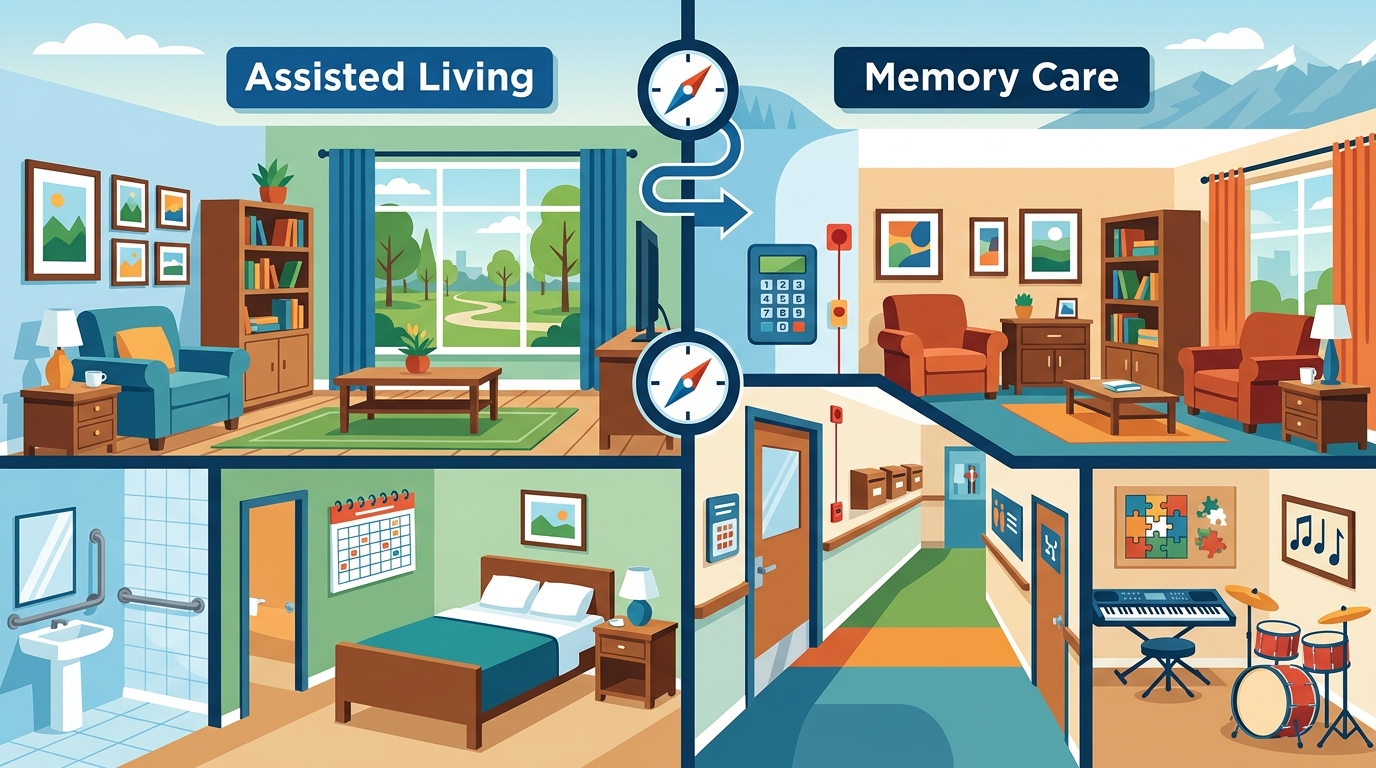
Memory care is a specialized level of care designed for individuals with Alzheimer's disease, dementia, or other cognitive impairments. The defining feature of these communities is security. They are designed to prevent wandering and provide staff trained specifically in dementia care. If your parent exhibits confusion about time, place, or people, memory care is likely the appropriate next step.
Cognitive Decline and Confusion
Look for significant memory loss that affects daily function. This includes forgetting recent events, repeating questions, or getting lost in familiar neighborhoods. In South Denver, a parent who wanders away from home or cannot find their way back is at high risk. Memory care units have secured entrances and exits, which is a critical safety feature not found in standard assisted living.
Need for Supervision
If your parent requires constant supervision to prevent harm to themselves or others, they need memory care. This includes behaviors like leaving the stove on, taking too many medications, or engaging in risky sexual behavior. The staff in memory care units are trained to manage these specific cognitive challenges with patience and specialized techniques.
The Role of Cognitive Assessment
A formal cognitive assessment is the most reliable way to distinguish between assisted living and memory care needs. While family members can observe changes, a professional evaluation provides an objective baseline. This assessment is usually conducted by a neurologist, geriatrician, or neuropsychologist.
Standardized Testing
Doctors use tools like the Mini-Mental State Examination (MMSE) or the Montreal Cognitive Assessment (MoCA) to measure cognitive function. These tests evaluate memory, attention, language, and visuospatial skills. A low score indicates cognitive impairment that may require the structured environment of memory care. If the score is normal but physical needs are high, assisted living is the better fit.
Diagnosis Specificity
It is important to know the specific type of dementia if one is present. Alzheimer's, vascular dementia, and Lewy body dementia present differently. For example, Lewy body dementia often involves visual hallucinations and sensitivity to certain medications. Knowing the specific diagnosis helps you choose a community with staff trained in that particular condition.
Safety Concerns and Home Hazards
Safety is the primary driver for moving a parent out of a home. In South Denver, many seniors live in single-story homes or apartments that may not be equipped for their current level of function. You must evaluate the home environment against your parent's current abilities.
Wandering and Elopement Risk
Home Modifications and Limitations
While you can install grab bars, remove rugs, and add lighting, these modifications have limits. If your parent is cognitively impaired, they may remove the grab bars or ignore the safety features. At a certain point, the home becomes a trap rather than a sanctuary. This is a critical moment to consider a professional care environment where safety is built into the architecture and staff training.
Understanding Dementia Behaviors
Dementia is not just memory loss; it involves a range of behavioral and psychological symptoms. Understanding these behaviors helps you determine if a standard assisted living community can handle them. Many assisted living staff are excellent at physical care but may not have the specialized training to manage complex dementia behaviors.
Agitation and Aggression
Some individuals with dementia become agitated, aggressive, or verbally abusive. This is often a response to pain, fear, or confusion. Memory care staff are trained in de-escalation techniques and non-pharmacological interventions. If your parent exhibits frequent aggression, a memory care unit is essential because the staff are equipped to handle these episodes safely and compassionately.
Psychotic Symptoms
Visual hallucinations and delusions are common in mid-to-late stage dementia. If your parent sees things that are not there or believes false things, they are in a state of distress. Memory care environments are designed to be calming and structured to reduce the triggers for these symptoms. Standard assisted living may not have the protocols to manage this level of psychological distress effectively.
Behavioral Changes and Emotional Shifts
Behavioral changes often precede physical decline. You may notice your parent becoming withdrawn, apathetic, or overly dependent. These emotional shifts are significant indicators of cognitive decline. They suggest that the brain is changing and that the person is losing their sense of self and control.
Loss of Interest and Apathy
If your parent stops enjoying hobbies, socializing, or activities they once loved, it may be a sign of depression or early dementia. While depression is treatable, it is often a symptom of the underlying cognitive decline. A professional evaluation can help distinguish between treatable depression and progressive dementia. This distinction is crucial for choosing the right level of care.
Increased Dependency
Some seniors become increasingly dependent on others for decision-making. They may ask for help with tasks they used to do easily. This shift in confidence and capability is a red flag. It indicates that the cognitive load of daily life is becoming too heavy. Memory care provides the structure and support needed to manage this dependency without overwhelming the individual.
The Importance of Medical Evaluation
Before making any placement decision, a comprehensive medical evaluation is non-negotiable. This evaluation should be conducted by a physician who specializes in geriatrics or neurology. It provides the medical evidence needed to justify the level of care and ensures that any underlying treatable conditions are addressed.
Comprehensive History and Exam
The doctor will take a detailed history of your parent's symptoms, medications, and lifestyle. They will perform a physical exam and order blood tests to rule out reversible causes of confusion, such as thyroid issues or vitamin deficiencies. This thorough approach ensures that you are not placing your parent in a higher level of care than necessary due to a treatable medical condition.
Documentation for Placement
Most senior living communities in Colorado require a medical evaluation before admission. This documentation helps the community understand your parent's needs and assign the appropriate level of care. It also protects your parent by ensuring that the facility is equipped to handle their specific medical and cognitive profile. Harbor Senior Placement can help you navigate this process and ensure that the evaluation is thorough and timely.
Assisted Living vs. Memory Care Comparison
| Feature | Assisted Living | Memory Care |
|---|---|---|
| Primary Need | Physical assistance with ADLs | Cognitive support and security |
| Security | Standard building security | Secured entrances/exits, alarmed doors |
| Staff Training | General care, CPR, first aid | Dementia-specific, de-escalation |
| Wandering Risk | Not suitable for wanderers | Designed for wanderers |
| Environment | Open, social, community-focused | Structured, calming, routine-based |
| Best For | Physically frail but cognitively intact | Cognitively impaired, dementia diagnosis |
Key Takeaways
- Assisted living is for physical needs; memory care is for cognitive needs.
- Wandering and elopement risk require a secured memory care environment.
- A formal cognitive assessment is the gold standard for determining care level.
- Behavioral symptoms like agitation and hallucinations indicate a need for specialized dementia care.
- Medical evaluation is required for placement and helps rule out reversible causes.
- Harbor Senior Placement provides free, local guidance to help you make this decision.
- Do not wait until a crisis occurs; early planning leads to better outcomes.
- Choose a community where the staff are trained in the specific type of dementia your parent has.
Frequently Asked Questions
Can a parent move from assisted living to memory care later?
Yes, many communities offer both levels of care. If your parent's cognitive decline progresses, they can transition to the memory care unit within the same community. This allows them to stay in a familiar environment with staff they already know, which reduces the stress of a major move.
How do I know if my parent is safe at home?
If your parent has had a fall, left the stove on, or wandered away, they are not safe at home. You should conduct a safety audit of the home and consider a professional evaluation. If the risks cannot be mitigated with home modifications and in-home care, a senior living community is the safer option.
Is memory care more expensive than assisted living?
Generally, yes. Memory care requires more staff and specialized training, which increases the cost. However, the cost is justified by the level of safety and specialized care provided. It is important to discuss costs openly with the community and understand what is included in the monthly fee.
What if my parent refuses to move?
This is a common and difficult challenge. It is important to approach the conversation with empathy and patience. Focus on the benefits of the new environment, such as social activities and safety. In some cases, a trial period or a short-term stay can help them adjust. Harbor Senior Placement can help you navigate these conversations and find a community that aligns with your parent's preferences.
Do I need a diagnosis of dementia to enter memory care?
Most memory care communities require a diagnosis of dementia or a significant cognitive impairment. This ensures that the residents are in the right environment and that the staff are prepared to care for them. A medical evaluation and diagnosis are typically required before admission.
How does Harbor Senior Placement help with this decision?
Harbor Senior Placement provides free, local guidance to families in South Denver. We help you understand the differences between care levels, arrange tours, and connect you with the right communities. Our goal is to ensure that your parent is in the safest and most appropriate environment for their needs.
Next Steps for South Denver Families
Making the decision between assisted living and memory care is one of the most difficult choices a family can face. It requires a clear understanding of your parent's physical and cognitive needs, as well as a thorough evaluation of the available options. By focusing on specific indicators, conducting a medical evaluation, and considering safety concerns, you can make an informed decision that prioritizes your parent's well-being.
At Harbor Senior Placement, we are here to support you through this process. We provide free, compassionate guidance to families in South Denver and surrounding areas. We help you navigate the complexities of senior living, from the initial assessment to the final move. If you are unsure about the right level of care for your parent, to start the conversation. We are here to help you find the right safe harbor for your loved one.